
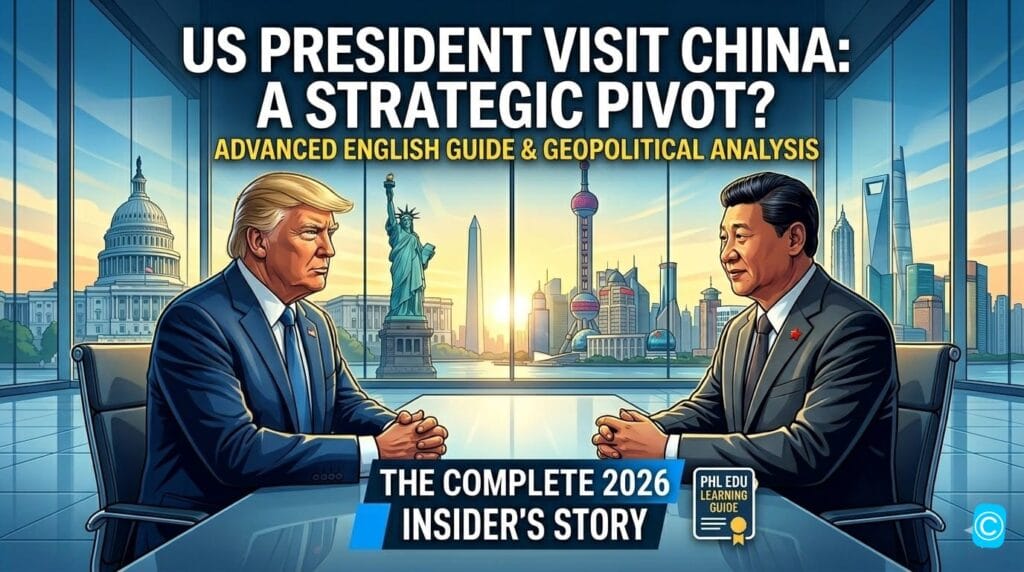
امریکی صدر کا دورۂ چین: عالمی سیاست کا نیا رخ یا محض سفارتی ڈرامہ؟
واشنگٹن اور بیجنگ کے درمیان بڑھتے ہوئے تناؤ، تجارتی جنگ اور سٹریٹیجک مسابقت کا ایک گہرا اور تفصیلی تجزیہ۔
1. The Geopolitical Framework of the Summit
The geopolitical landscape of the 21st century faced a critical juncture as the President of the United States embarked on a highly anticipated state visit to Beijing. Against a backdrop of prolonged economic friction, tech protectionism, and maritime disputes in the South China Sea, the bilateral summit was heavily scrutinized by international observers. For months leading up to the rendezvous, diplomatic channels in both Washington and Beijing had been operating under immense pressure to draft an itinerary that could accommodate the starkly contrasting objectives of the world’s two largest economies. The overarching question looming over the international community was whether this high-profile diplomacy would yield tangible breakthroughs or merely serve as a superficial photo-op in the history of contemporary international relations.
Upon arrival, the American delegation was met with meticulous diplomatic protocol, underscoring the gravity of the systemic rivalry between the two superpowers. The initial rhetoric radiating from both camps was characterized by cautious optimism, with both leaders emphasizing the necessity of establishing structural guardrails to prevent competition from veering into open conflict. However, underneath the veneer of diplomatic pleasantries lay a profound layer of strategic distrust. The United States entered the negotiations with a firm mandate to address market access barriers, intellectual property theft, and the massive trade deficit that has long compromised bilateral economic equilibrium. Conversely, the Chinese leadership remained fiercely defensive, viewing Washington’s evolving trade restrictions as a calculated strategy of economic containment aimed at stifling Beijing’s technological ascension.
2. High-Stakes Negotiations and Economic Friction
The core of the summit devolved into intensive, closed-door deliberations where negotiators grappled with structural macroeconomic discrepancies. The American side consistently pointed to Beijing’s state-subsidized industries, particularly in green technology and electric vehicles, arguing that these practices artificially distort global supply chains and disadvantage Western manufacturers. This cut-throat competition has triggered intense domestic pressure within the United States to implement stringent tariffs, a move that Beijing has vehemently denounced as an infringement on free-trade principles. The Chinese counterpart, in a resolute counter-stance, demanded the immediate rescission of unilateral export controls imposed on advanced semiconductors, characterizing them as a violation of global market norms.
As the dialogue progressed into the second day, a labyrinth of security concerns further complicated the economic agenda. The militarization of crucial trade pathways and the volatile status of regional flashpoints added a palpable layer of tension to the negotiations. Geopolitical pundits noted that the body language of the defense attachés present during the broader security briefings suggested a rigid adherence to their respective strategic doctrines. While the United States reiterated its unwavering commitment to upholding a rules-based international order and ensuring freedom of navigation, Beijing firmly stood its ground, emphasizing that internal sovereign matters were non-negotiable and that foreign intervention would be met with swift diplomatic and economic countermeasures.
3. Tangible Breakthroughs vs. Diplomatic Stalemate
Despite the pervasive friction, the summit did not culminate in a total fiasco. Diplomatic pragmatism prevailed in specific sectors where mutual interests intersected. Both nations managed to secure a tentative consensus on reviving high-level military-to-military communication channels, a mechanism that had been dangerously suspended following recent escalations. This development was widely heralded as a significant silver lining, providing a crucial safety valve to mitigate the risk of miscalculation or inadvertent military encounters in contested waters. Additionally, working groups were established to facilitate institutional collaboration on transnational crises, including global climate change mitigation and artificial intelligence governance frameworks.
However, these administrative adjustments fell short of a fundamental reset in bilateral relations. On the critical issues of structural economic reforms and systemic technological competition, the two superpowers remained fundamentally poles apart. The joint press release, though meticulously parsed to convey a sense of diplomatic progress, could not entirely obscure the underlying stalemate. The carefully measured statements delivered by the respective heads of state reflected a mutual recognition that while coexistence is an absolute necessity, structural alignment remains an elusive prospect in an era defined by zero-sum geopolitical competition.
4. Conclusion: Evaluating the Strategic Legacy
In final analysis, categorizing the US President’s state visit to China as an absolute triumph or a dismal failure would be an oversimplification of a highly complex diplomatic exercise. The truth invariably resides within a nuanced gray area. The summit did not produce a monumental treaty that would permanently alter the trajectory of US-China relations, nor did it spark a sudden resolution to the underlying trade wars. To expect such an outcome would be to misunderstand the deep-seated structural rivalries that drive both nations on the global chessboard.
The true value of this high-stakes encounter lies in the preservation of dialogue. By keeping lines of communication open and formalizing crisis-management protocols, both Washington and Beijing have effectively managed to avert a destabilizing escalation. The ice has certainly not melted, and the strategic competition will undoubtedly persist across economic, technological, and military domains. Nevertheless, by choosing structured negotiation over unmitigated hostility, the global community has been granted a temporary reprieve from the impending threat of an unmanageable superpower conflict.
مشکل الفاظ، تلفظ اور مستند معانی (Vocabulary Guide)
| English Word | اردو تلفظ | مستند معنی |
|---|---|---|
| Protectionism | پروٹیکشن ازم | تحفظ پسندی (مقامی صنعتوں کو بچانے کے لیے بیرونی درآمدات پر ٹیکس لگانا) |
| Scrutinized | سکروٹنائزڈ | باریک بینی سے جائزہ لیا گیا، کڑی نگرانی کی گئی |
| Equilibrium | اکوئلیبریم | توازن، اعتدال، برابری کی حالت |
| Ascension | اسینشن | بلندی، عروج، اوپر کی طرف پیش قدمی |
| Discrepancies | ڈسکریپنسیز | اختلافات، تضادات، عدم مطابقت |
| Resolute | ریزولیٹ | پختہ، پُرعزم، غیر متزلزل |
| Pundits | پنڈٹس | ماہرین، مبصرین، تجزیہ کار |
| Countermeasures | کاؤنٹر میژرز | جوابی کارروائیاں، بچاؤ کی تدابیر |
| Pragmatism | پریگمیٹزم | حقیقت پسندی، عملیت پسندی (نظریات کے بجائے حالات کے مطابق فیصلہ کرنا) |
| Inadvertent | ان ایڈورٹنٹ | غیر ارادی، نادانستہ، بغیر سوچے سمجھے |
| Meticulously | میٹیکولسلی | انتہائی باریک بینی سے، نہایت احتیاط کے ساتھ |
| Reprieve | ریپریو | وقتی ریلیف، مہلت، سزا یا مصیبت میں عارضی تاخیر |
Designed specifically for phledu.com | Premium English Learning Platform.



Your courses are very good. Please keep updating them like this.
Your coursesYour courses are very good.