🇵🇰 Pakistan → MIT Admission Guide
How to Get Into MIT from Pakistan: Step-by-Step Admission Guide (2026–27)
A realistic roadmap for Pakistani students — SAT/ACT, English tests, essays, financial aid, visa and backup universities
If you are wondering how to get into MIT from Pakistan, the short answer is that you apply directly to the Massachusetts Institute of Technology through its own online application — there is no agent requirement, no country quota, and no separate “international route.” The honest long answer is that MIT is extremely selective, so the real question is how to build an application that MIT’s readers can recognise as yours. This guide walks Pakistani students through the whole path: what MIT looks for, a stage-by-stage roadmap, SAT/ACT and English-test planning, essays, school records, financial aid, visa steps, and backup universities. Every figure is labelled with its year, and every deadline should be confirmed on MIT’s official website before you submit.
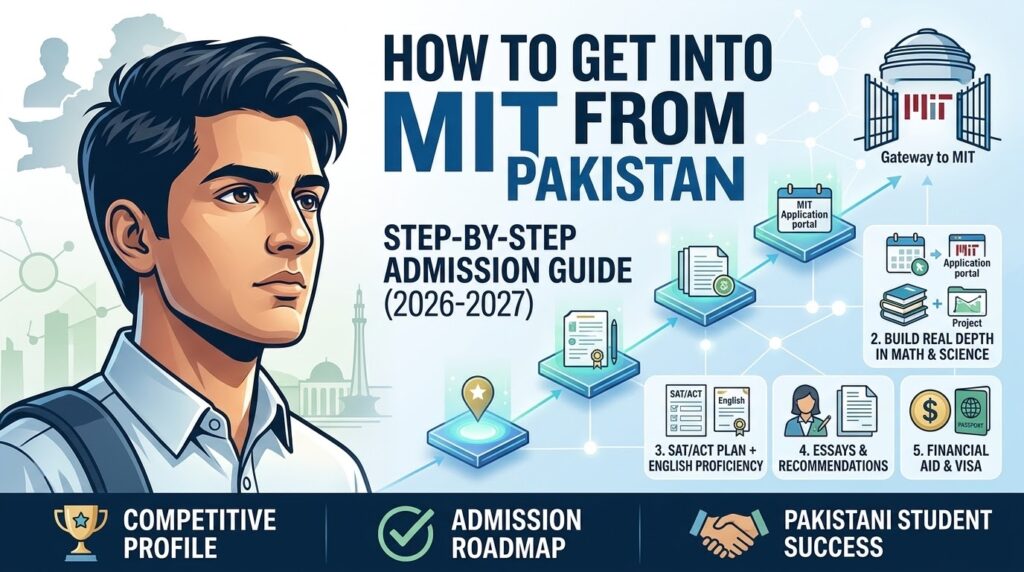
- Build real depth in math and science, plus one project or interest that is genuinely yours
- Plan your SAT or ACT so you test before MIT’s test deadline
- Check whether MIT strongly recommends an English proficiency exam for you
- Ask your school to prepare your Secondary School Report and line up two teacher letters
- Write MIT’s short essays and activity entries in your own specific voice
- Submit by Early Action (November 1) or Regular Action (January 4)
- File the CSS Profile and income documents for need-based aid by the separate aid deadline
- If admitted, complete visa planning with MIT’s International Students Office
Can Pakistani Students Really Get Into MIT?
Yes — Pakistani students apply to MIT every year, and MIT states that it has no caps or quotas for countries. It treats anyone who is not a U.S. citizen or permanent resident as an international applicant, and that status does not change when you apply or how you are considered for aid.
The challenge is competition, not nationality rules. For the Class of 2029, MIT received 29,281 first-year applications and admitted 1,334 students (4.6%). Among international applicants, 6,926 applied and 136 were admitted — roughly 2%. MIT’s published numbers do not explain why the international rate is lower, so read it as a sign of how strong the global pool is, not as a rule against any one country. It is also a historical figure for one entering class, not a promise about the cycle you are applying in.
Source: MIT Admissions statistics. For the full ranking, fees and department overview, see our MIT university profile.
What Does MIT Look for in Applicants?
MIT describes its selection as holistic: each application is read in its own context, with no quotas by school, state or region and no preference for alumni relations. Beyond outstanding academic achievement, MIT lists a set of qualities it wants to see in the person behind the grades. The table below translates those qualities into the kind of evidence a Pakistani applicant could realistically show. The examples are our ideas, not MIT requirements.
| Quality MIT lists | What it means in practice | Example of evidence |
|---|---|---|
| Alignment with MIT’s mission | You want to use science and technology to improve something for other people | A local problem you studied closely and tried to address |
| Collaborative and cooperative spirit | You build things with others instead of only competing | A study group, robotics team or community project you helped run |
| Initiative and risk-taking | You start things nobody assigned and accept that some will fail | A club, tutoring circle or open-source contribution you started |
| Hands-on creativity | You make, build, repair or test, not only study theory | A working device, app, experiment or design with real documentation |
| Intensity, curiosity and excitement | You go deeper than the syllabus because you want to | A topic you read, coded or experimented with well beyond class |
| Balancing hard work with downtime | You are a whole person, not a burnt-out résumé | An honest interest outside academics that you genuinely enjoy |
Source: MIT’s published admission criteria, see MIT Facts — Admission and mitadmissions.org.
How to Get Into MIT from Pakistan: Step-by-Step Roadmap
Know the calendar before anything else
MIT’s dates drive everything else, so work backwards from them. These are the dates for the current first-year cycle as published by MIT Admissions (checked October 2026); for the 2026–27 cycle that means November 1, 2026 and January 4, 2027.
| Milestone | Early Action | Regular Action |
|---|---|---|
| Application due | November 1 | January 4 |
| Decisions released | Mid-December | Mid-March |
| Take required tests before | November 30 | December 31 |
| Financial aid forms due (CSS Profile and income documents) | November 30 | February 15 |
Which round? Choose Early Action only if your tests, records, letters and essays are already strong and ready. A rushed application in November is not better than a polished one in January.
Prepare the academics MIT expects
MIT does not require a fixed list of high school classes, but it expects solid competence in the fields you plan to keep studying. It does not convert your grades into a U.S. system; its readers are trained to understand education systems around the world. In practice, that means taking the most demanding math and science route your school offers, and doing well in it, whether you are in FSc, A Levels, IB or another system.
Plan your SAT or ACT early
MIT requires either the SAT or the ACT, and it accepts the paper or digital SAT. MIT sets no cutoff scores. For context, the middle 50% of admitted students in the Class of 2029 scored 780–800 on SAT Math, 740–780 on SAT Evidence-Based Reading and Writing, and 34–36 on the ACT Composite. Those numbers come from a holistic process and are not minimums.
Check the College Board and ACT websites for test centres and dates actually available to you, and book early, because seats and dates can be limited. Leave room for a retake before the November 30 or December 31 deadline rather than testing for the first time at the last possible date.
Decide whether you need an English proficiency exam
MIT strongly recommends an English exam if you have used English for fewer than five years, or if you do not speak English at home or in school. If that describes you, these are MIT’s published scores:
| Test | Minimum | Recommended |
|---|---|---|
| IELTS | 7 | 7.5 |
| TOEFL (taken on or after 21 Jan 2026, 1–6 scale) | 5 | 5.5 |
| PTE Academic | 65 | 70 |
| Duolingo English Test | 120 | 125 |
Preparing for IELTS or building academic vocabulary also helps your essays. Our IELTS preparation guides, the PHL Word Bank and PHL Quizzes are free places to practise.
Organise school records and recommendations
Your school sends a Secondary School Report with your transcript, prepared by a counsellor or an equivalent school official, along with results of external exams required for university entrance in your country. If your school has no formal counsellor, ask the administration which official can complete the report, and do it weeks early. MIT also asks for two teacher letters: it recommends one from a math or science teacher and one from a humanities, social science or language teacher.
Give your teachers specifics — what you built, solved or struggled with in their class — so their letters describe you rather than repeat your grades. Check MIT’s transcripts guidance for how to present records that are not issued in English.
Complete the application, fee and optional interview
You apply through MIT’s own online portal. The application fee is US$75, or you can request a fee waiver. An interview may be offered by an MIT Educational Counselor if one is available in your area; if none is available, the interview is waived and your application is not adversely affected, so do not worry if you never receive an invitation.
Apply for financial aid separately
Aid is a separate process with its own deadline. Start collecting income documents months ahead; the details are in the cost section below.
Plan the visa and arrival
If admitted, you will generally need a U.S. student visa. See the visa section below for how to prepare.
How to Build a Strong MIT Profile in Your Final School Years
MIT does not publish an approved list of activities, and it explicitly values depth over a long résumé. The plan below is our suggested way to organise your time, not an MIT rule, and it does not guarantee any result.
| Stage | Focus | Practical actions |
|---|---|---|
| Early secondary years (Matric / O Levels) | Foundations and curiosity | Master math and physics basics; start one small build, experiment or coding project; read beyond the textbook |
| Penultimate year (FSc part 1 / AS / IB year 1) | Depth and proof | Deepen the project; try science fairs, olympiads or coding contests; look for a mentor; begin SAT or ACT preparation |
| Final year (FSc part 2 / A2 / IB year 2) | Execution | Finish tests, request records and letters, write essays, and submit before the deadline |
Projects that read as “hands-on creativity”
- A working prototype with photos, code or measurements — for example a low-cost sensor, a small robot or a tool that solves a problem in your school or neighbourhood
- A data project built from real local information, with a clear question and an honest conclusion
- Teaching or mentoring younger students in a subject you love, with something concrete you built for them
- Online or open-source contributions that others actually use
One serious, documented project almost always reads better than ten joined clubs. Keep proof — links, photos, notes — so you can describe your work accurately in your activity entries.
MIT Essays and Short Answers: How to Write Them Well
MIT does not use the Common Application. All of your writing is completed inside MIT’s own portal, in several short essays and short-response questions rather than one long personal statement. MIT has changed its questions and word limits between cycles, and different counselling websites currently describe the 2026–27 set differently, so read the questions and limits on MIT’s official essays page before you draft anything and ignore older sample answers.
Principles that hold whatever the prompts are
- Be specific. One concrete detail — a number, a place, a failed attempt — beats a general statement about passion.
- Answer exactly what is asked. In very short responses, give your answer, one example and stop.
- Write about your real context. A problem you have personally seen in your city or school is more convincing than a famous global problem borrowed from a speech.
- Show enjoyment, not only achievement. MIT asks about things you do for fun; an honest answer is better than an impressive-sounding one.
- Avoid clichés. Phrases like “I want to change the world” say nothing without evidence next to them.
- Use your own voice. Readers go through thousands of applications, and writing that sounds like anyone could have produced it is easy to forget. Ask a teacher to check clarity, not to rewrite you.
Official source: MIT Admissions — Essays, activities & academics.
Can Pakistani Families Afford MIT? Cost vs Financial Aid
MIT’s published undergraduate cost of attendance for 2026–2027 is US$92,760 before aid, of which tuition is US$66,720. That headline number frightens many families, but it is not the number most admitted students pay, because MIT’s aid is built around family need.
How MIT financial aid works for international students
- MIT says it is need-blind in admissions and meets 100% of the demonstrated financial need of admitted students who apply for aid, regardless of citizenship.
- MIT gives no merit scholarships. Aid is based on family need, so it is neither automatic nor guaranteed for every applicant.
- Since 2025–2026, students whose family income is under US$200,000 a year (with typical assets) attend MIT tuition-free, and families under US$100,000 (with typical assets) are not expected to contribute.
- The default student contribution is US$5,400 (US$2,000 from summer savings and US$3,400 from term-time work).
- International applicants apply with the CSS Profile and parental income documentation through College Board’s IDOC. If parents live outside the U.S., MIT asks for translated tax or income records.
“Tuition-free” does not mean every cost is covered; housing, food, books, personal expenses and travel still count in your budget. For other options, see our guide to fully funded scholarships in 2027.
Sources: MIT Admissions — how much it costs, how to apply for aid, and MIT Student Financial Services. Policies and fees change yearly.
US Student Visa and Arrival Planning After an MIT Offer
- Admitted international students generally need a U.S. student visa. MIT’s International Students Office guides admitted students through the documents.
- Visa decisions are made by U.S. authorities, not by MIT, and no outcome is guaranteed.
- Keep your passport valid, and keep financial and academic documents organised and consistent with what you told MIT.
- You do not need to pay an agent to apply. EducationUSA, a U.S. government network, offers free advising, and be careful with anyone who promises guaranteed admission or a guaranteed visa.
Applying to MIT for MS or PhD from Pakistan
If you are finishing a bachelor’s degree in Pakistan, the route is different from the undergraduate one. Graduate admission is handled department by department, so deadlines, required materials and test requirements vary by program.
- Choose the department first. Read each department’s own admissions page and the research areas of its faculty before you write anything.
- English test: unless you qualify for an automatic exemption, applicants whose first language is not English submit an accepted proficiency test (IELTS Academic, TOEFL iBT, Cambridge Advanced or Proficiency, or Duolingo, depending on the department).
- After admission: enrolling international graduate students take MIT’s English Evaluation Test before the fall semester and must show they can meet MIT’s minimum budget projection before an F-1 or J-1 visa document is issued.
- MIT Sloan runs its own admissions process for programs such as the MBA.
Funding differs between programs, so confirm it on the department page. Our Top 10 Universities in Pakistan (2026) guide helps you compare your undergraduate options, and the fully funded scholarships guide lists funding routes beyond MIT.
Official source: MIT Office of Graduate Education — international applicants.
Common Mistakes Pakistani Applicants Make When Applying to MIT
- Treating MIT as a marks-only contest. Grades and tests open the door, but MIT’s own criteria are about initiative, creativity and fit.
- Paying an agent for “guaranteed admission”. No one can guarantee it, and you apply directly to MIT for free advice from EducationUSA.
- Booking the SAT or ACT too late. Limited centres and dates can leave you with no retake before the deadline.
- Missing the aid deadline. The CSS Profile and income documents have their own dates.
- Writing generic essays. A borrowed big idea is weaker than one real problem you have actually seen.
- Applying only to MIT. With a single-digit acceptance rate, a thoughtful list of other universities is part of a sensible plan, not a lack of ambition.
- Relying on old information. Dates, prompts, fees and policies change every year, so confirm everything on MIT’s official site.
Universities to Apply to Alongside MIT
A strong application list mixes highly selective schools with options that fit your budget and profile. The rankings below are from the PHL EDU World Top 100 Universities directory, based on the QS World University Rankings 2027, and each link opens a full profile.
Other highly selective U.S. universities
Strong options outside the U.S.
Several of these, including ETH Zurich, TUM and the University of Tokyo, are noted in our profiles for remarkably low tuition, which can matter a great deal when you compare total cost. Browse every profile in the complete Top 100 directory.
Frequently Asked Questions
Apply directly through MIT’s own online application as an international applicant. Submit the SAT or ACT, a Secondary School Report with transcript, two teacher letters of recommendation, MIT’s short essays and activity entries, and an English proficiency exam if MIT’s guidance applies to you. MIT has no country quotas and does not require an agent.
Early Action is due November 1 and Regular Action is due January 4, with decisions in mid-December and mid-March. Required tests must be taken before November 30 for Early Action or December 31 for Regular Action. Financial aid forms are due November 30 for Early Action and February 15 for Regular Action.
MIT sets no cutoff scores. For the Class of 2029, the middle 50% of admitted students scored 780–800 on SAT Math and 740–780 on SAT Evidence-Based Reading and Writing, or 34–36 on the ACT Composite. These reflect a holistic review, not minimums.
Not for everyone. MIT strongly recommends an English proficiency exam if you have used English for fewer than five years or do not speak English at home or in school. For IELTS, the minimum is 7 and the recommended score is 7.5. You can prepare with our free IELTS preparation guides.
MIT gives need-based financial aid and no merit scholarships. It meets 100% of the demonstrated need of admitted students who apply for aid, regardless of citizenship. Students from families with income under US$200,000 (with typical assets) attend tuition-free, but aid is awarded on need and is not automatic or guaranteed.
No. You apply directly to MIT, and EducationUSA, a U.S. government network, offers free advising. Be cautious about anyone who guarantees admission or a visa, because neither can be guaranteed.
An interview may be offered by an MIT Educational Counselor if one is available. If no counselor is available, the interview is waived and your application is not adversely affected.
MIT’s undergraduate process is the first-year application, completed while finishing secondary school. Your school sends a Secondary School Report with your transcript and the results of external exams used for university entry in your country, such as A Levels or IB where applicable. Check MIT’s transcripts guidance for how to present records from your education system.
MIT does not set a start date, but most applicants benefit from beginning two to three years ahead. That gives time to build strong grades in math and science, develop one serious project, plan the SAT or ACT, and gather records and recommendations before the deadline. See the full list of world top universities to build your wider list.
Disclaimer: This guide is based on MIT Admissions, MIT Student Financial Services, MIT’s Office of Graduate Education and the QS World University Rankings 2027 as shown in the PHL EDU directory, and was last checked in October 2026. The roadmap, examples and mistakes lists are our own editorial advice, not MIT requirements. Deadlines, prompts, fees, scores and policies change every year, and no admission, funding, visa or employment outcome is guaranteed. Always verify current details directly with MIT before applying.