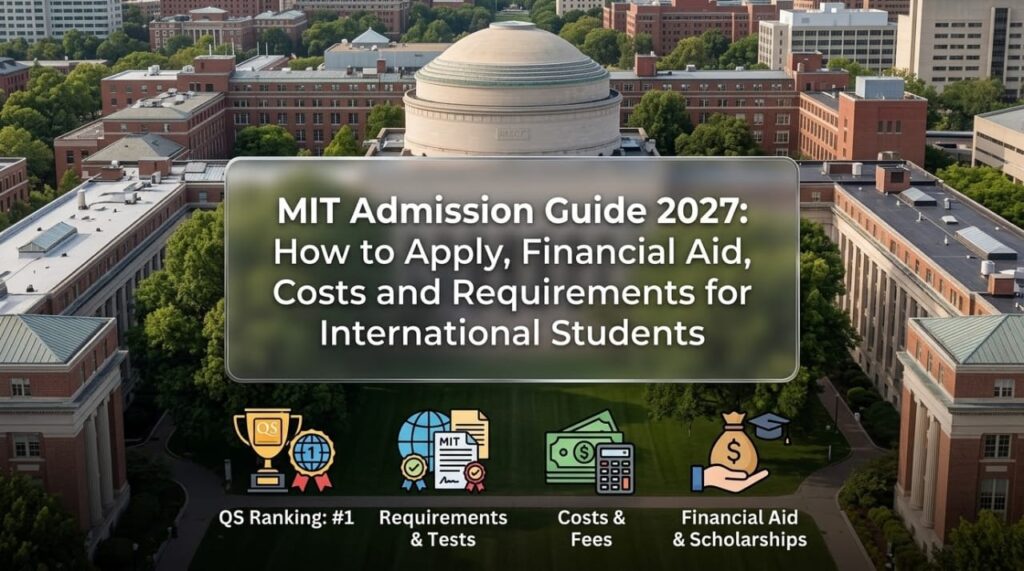
MIT Admission Guide 2027: How to Apply, Financial Aid, Costs and Requirements for International Students
MIT admission is one of the hardest doors in engineering and technology, yet it is among the few that treats every nationality alike on money. This MIT Admission Guide 2027 explains how to apply for fall 2027 entry: Early Action versus Regular Action, the SAT or ACT rule, how need-blind aid works for non-US families, what MIT costs and what to do after an offer. Facts come from MIT and other official sources checked in October 2026. For ranking and a quick overview, see our MIT profile page.
MIT QS Ranking 2027: Why Is MIT Ranked Number One?
MIT is first in the world in the QS World University Rankings 2027, its 15th consecutive year at the top, and you can compare it with every other top-100 university in our World’s Top 100 Universities directory. The reputation rests on engineering, computer science, physics and a culture of building things: undergraduates join one of the Institute’s numbered “Courses” and share a common core of science and mathematics first.
MIT sits in Cambridge, Massachusetts, a short ride from Harvard, and students can cross-register for classes there. If you are weighing the two, read our Harvard admission guide next to this one.
What Is the MIT Acceptance Rate?
MIT’s own statistics page for the Class of 2029 shows 29,281 first-year applications and 1,334 admits, a 4.6% admit rate. Early Action had 12,052 applicants and 721 admits (about 6.0%). Secondary sources report a similar 4.6% for the Class of 2030 (1,299 of 28,349), but MIT had not published the full breakdown when we checked, so use MIT’s page for the latest numbers.
The figure that matters most to you is the international one: 6,926 international students applied and 136 were admitted, about 2.0%. MIT does not explain the gap, so read it as a sign of how strong the worldwide pool is, not as a rule against any country. Early Action is not an advantage in itself, because its higher rate mostly reflects a more self-selected pool.
MIT Admission Requirements for International Students
- One application for everyone: international and US applicants follow the same process, and MIT states that international applicants are not held to a quota.
- Strong maths and science: expect calculus-level mathematics and serious work in physics, chemistry or biology, because the first-year core assumes it.
- Short-answer questions about what you do and why, written in your own voice, plus recommendations from teachers.
- Optional portfolios: MIT lets you submit a Maker Portfolio or arts, music or research work if it adds real evidence of your skills.
- Interview: an alumni interview is offered where an interviewer is available, and the application fee is US$75, with waivers for need.
SAT, ACT and English Test Rules for MIT
SAT or ACT is required. MIT never adopted a permanent test-optional policy, accepts the paper or digital SAT, and publishes no cutoff. For context, the middle 50% of admitted Class of 2029 students scored 780 to 800 on SAT Math, 740 to 780 on SAT Evidence-Based Reading and Writing, and 34 to 36 on the ACT Composite. Take your tests before 30 November for Early Action or 31 December for Regular Action.
English exam: MIT strongly recommends one if you have used English for fewer than five years, or if you do not speak English at home or at school. Its published scores are:
Swipe sideways to see the full table
| Test | Minimum | Recommended |
|---|---|---|
| IELTS | 7 | 7.5 |
| TOEFL (taken on or after 21 January 2026, 1 to 6 scale) | 5 | 5.5 |
| PTE Academic | 65 | 70 |
| Duolingo English Test | 120 | 125 |
Build your English with our IELTS preparation guides, the One Word, One Page vocabulary database and the 1500 advanced English words list.
How to Apply to MIT: Step by Step
- Choose a test date that lets scores arrive before your deadline, and register early for a centre near you.
- Start the MIT application in the summer, including the short answers and any optional portfolio.
- Ask two teachers and your counsellor for recommendations well before November.
- Decide between Early and Regular Action using the table in the next section.
- Applying from Pakistan? Follow our dedicated how to get into MIT from Pakistan roadmap alongside this guide.
- Submit the aid forms if you need aid; MIT never shows them to admissions officers.
- Prepare documents with our PDF Toolkit and polish your writing in the AI Language Studio.
- After an offer, confirm by the reply date and start the F-1 visa process.
Explore Related Guides & Rankings
MIT Application Deadlines 2027
Swipe sideways to see the full table
| What | Early Action | Regular Action |
|---|---|---|
| Application due | 1 November 2026 | 4 January 2027 |
| Decisions released | Mid-December 2026 | Mid-March 2027 |
| Take required tests before | 30 November 2026 | 31 December 2026 |
| Financial aid forms due | 30 November 2026 | 15 February 2027 |
| Reply date | 1 May 2027 | 1 May 2027 |
MIT Tuition and Cost of Attendance
MIT’s published 2026–27 cost of attendance is US$92,760 before aid, of which tuition is US$66,720. Confirm it on MIT Student Financial Services, because costs rise every year.
Simple arithmetic (our calculation) shows why the sticker price misleads. Four years at the 2026–27 rate would be about US$371,040. But when tuition is covered by aid, the remaining costs (housing, food, books, personal expenses) are about US$26,040 a year, and below the lowest income band even most of that is covered.
MIT Financial Aid for International Students
- Need-blind for everyone: MIT does not consider your ability to pay when deciding on admission, including for international applicants, and meets 100% of demonstrated need for admitted students who apply for aid.
- Income bands (since 2025–26): families earning under US$200,000 with typical assets attend tuition-free, and families under US$100,000 are not expected to contribute toward the cost of attendance.
- Student contribution: the default expectation is US$5,400 a year (US$2,000 from summer savings and US$3,400 from term-time work).
- Forms: international applicants submit the CSS Profile and parental income documents through College Board’s IDOC, and MIT asks for translated tax or income records when parents live outside the US.
- No merit scholarships: every dollar of aid is need-based, so it is neither automatic nor guaranteed.
“Tuition-free” does not cover every cost. For other routes to funding see our fully funded scholarships for 2027.
F-1 Student Visa After MIT Admission
Admitted students normally enter the US on an F-1 visa. MIT’s international office issues the I-20 once you accept, and you then pay the SEVIS fee, complete the DS-160 form and attend a visa interview. Visa decisions belong to the US government, so rules and waiting times can change, and you should apply as soon as the I-20 arrives. After graduation, F-1 students can usually apply for Optional Practical Training, with an extension for qualifying STEM degrees. Confirm current rules and never assume a job outcome.
Mistakes That Cost MIT Applicants
- Assuming test scores are optional because many peers dropped them (MIT requires them).
- Submitting a portfolio that adds volume, not evidence.
- Applying early with an unfinished file.
- Missing the separate aid deadlines.
- Quoting last year’s tuition when the 2026–27 figure is higher.
Frequently Asked Questions About MIT Admission
They use the same application as US students, with SAT or ACT scores, short-answer questions, recommendations and an optional alumni interview. MIT has no quota for international applicants.
Early Action closes on 1 November 2026 and Regular Action closes on 4 January 2027. MIT’s Early Action is non-binding.
Yes. MIT requires an SAT or ACT score from every first-year applicant and has never adopted a permanent test-optional policy.
Yes. MIT does not consider ability to pay in admission decisions, including for international applicants, and meets 100% of demonstrated need.
MIT’s published 2026–27 cost of attendance is US$92,760, including US$66,720 tuition. Most students pay much less because of need-based aid.
Under MIT’s aid expansion, families earning under US$200,000 with typical assets pay no tuition, and those under US$100,000 pay nothing toward the full cost of attendance.
For the Class of 2029, MIT admitted 1,334 of 29,281 applicants, 4.6%. Among international applicants, 136 of 6,926 were admitted, about 2.0%.
MIT strongly recommends one if you have used English for fewer than five years or do not speak English at home or at school. The published IELTS minimum is 7, with 7.5 recommended.
MIT is ranked first in the QS World University Rankings 2027, its 15th consecutive year at number one.
MIT Admission for Pakistani Students
Pakistani applicants follow the same process as everyone else at MIT. For a stage-by-stage plan written for Pakistani students (profile building, essays, school records and backup universities), read our complete roadmap: how to get into MIT from Pakistan. This table is the quick checklist.
| Area | What Pakistani applicants should do |
|---|---|
| School records | Ask your school to send transcripts and recommendations. If you study O/A-levels or the IB, predicted grades are sent too, with originals plus any official translation |
| Tests | Plan the SAT or ACT well ahead and book a Pakistan centre early. Start your English work with our IELTS preparation guides |
| Application | Apply directly. No agent is needed, and free EducationUSA advising is available |
| Funding | MIT is need-blind and meets full need for international students. Convert family income from PKR to USD, use MIT’s calculator and meet the aid dates |
| Visa | Apply for the F-1 visa after admission. Visa decisions are made by US authorities, so check State Department rules and appointment wait times for Pakistan early |
| Start time | Begin 12 to 18 months before intake: test dates, attested documents, recommendations and visa slots all take time |
More PHL EDU University Admission Guides
Comparing universities? Every guide in this series follows the same plan: ranking, requirements, deadlines, costs, funding, visa and a Pakistan checklist. Browse them all, or open the full World’s Top 100 Universities directory for rankings and profiles.
Free tools that help with your application: AI Language Studio, PDF Toolkit, Word Bank, One Word, One Page, IELTS preparation guides, fully funded scholarships for 2027 and the PHL EDU blog.
Disclaimer: This article uses MIT’s official admissions and financial aid pages, other public sources and the QS World University Rankings 2027, last checked in October 2026. Fees, deadlines, scholarships, test rules and visa rules change, and no admission, funding, visa or job outcome is guaranteed. Always confirm details with MIT and the relevant government before applying.