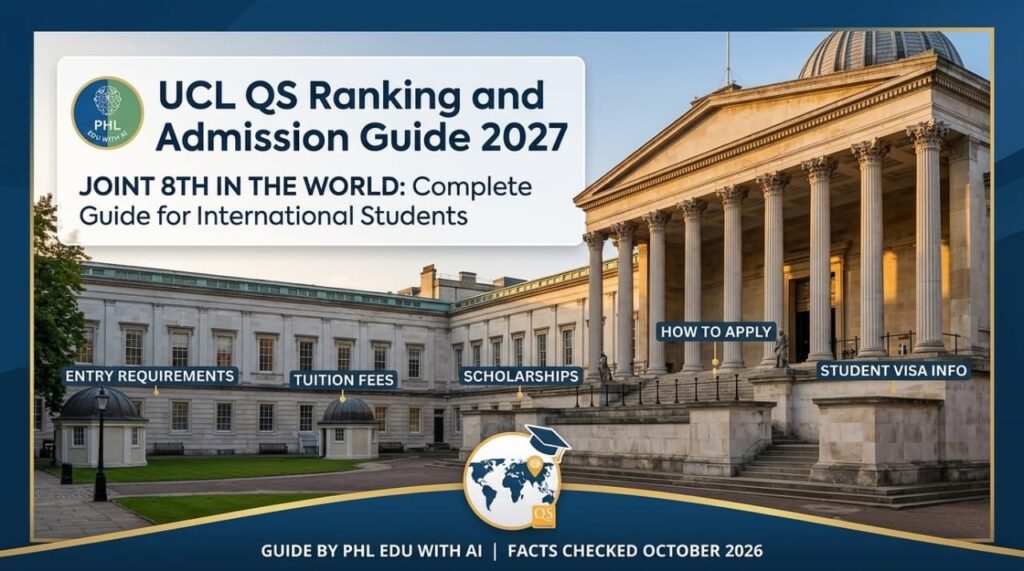
UCL QS Ranking and Admission Guide 2027: Entry Requirements, Fees, Scholarships and How to Apply
The UCL QS ranking for 2027 is joint 8th in the world, and that number is the reason many students start looking at University College London. This UCL QS Ranking and Admission Guide 2027 goes further than the number: it shows how the ranking has moved over ten years, how UCL compares with other universities, and then walks you through UCAS and postgraduate applications, English tests, fees, London living costs, visa money, scholarships and the Graduate Route. Every date and figure was checked against UCL, UK government and QS sources in October 2026. For a short profile first, see our UCL profile page.
UCL QS Ranking 2027: What Does Joint 8th Mean?
In the QS World University Rankings 2027, published in June 2026, UCL is joint 8th, tied with ETH Zurich and up one place from 9th. UCL’s own news release says it ranks second in the world for international research networks and third globally for sustainability. UCL also records that U.S. News & World Report placed it 9th in its 2026–27 Best Global Universities list, so the picture across ranking systems is consistent: a world top-ten university.
UCL publishes its QS history, which is the most useful way to read the latest result:
The pattern is stability, not a surge: UCL has sat between 7th and 10th for the whole decade. Moving one place at this level usually reflects small score differences, so do not treat 8th versus 9th as a quality gap. QS builds its score from academic and employer reputation, research citations, staff-student ratio and international faculty and students, and other rankers weigh different factors. The most practical advice is to check the QS subject ranking for the course you want, because overall rank says little about one department. You can read UCL’s official statements on its rankings page.
UCL QS Ranking vs University of Manchester QS Ranking, HKU QS Ranking and Boston University
Students who search for the UCL QS ranking often compare it with other universities they are considering. Here is how the 2027 QS positions line up, using the figures on our profile pages:
Swipe sideways to see the full table
| University | QS World Rank 2027 | Read more |
|---|---|---|
| University College London (UCL) | Joint 8th | UCL profile |
| The University of Hong Kong (HKU QS ranking) | 11th | HKU profile · HKU guide |
| University of Manchester (University of Manchester QS ranking) | Joint 40th | Manchester profile · Manchester guide |
| Boston University (often searched as “University of Boston”) | 94th | Boston University profile · Boston University guide |
Rank alone should not decide your choice. UCL, Manchester, HKU and Boston University sit in four different countries with different fee levels, visa rules and costs, so compare total cost and entry requirements as well. You can see every university in the top 100 in our World’s Top 100 Universities directory.
Why Do Students Choose UCL?
UCL was founded in 1826 in Bloomsbury, central London, as a university open to students regardless of religion, and it offers more than 440 undergraduate degrees across sciences, engineering, medicine, architecture, law, social sciences, humanities and education. Its location puts students close to London’s hospitals, law firms, media, finance and technology employers, and the university’s accommodation guarantee, scholarships and Graduate Route access (covered below) add practical value. The trade-off is cost: London is one of the most expensive student cities in the world.
What Is the UCL Acceptance Rate?
UCL does not publish a single acceptance rate for all courses. Third-party websites quote an offer rate of around 43% based on 2025/26 UCAS-type data, but that figure is not official, and UCAS applicants apply to several universities at once, so the number does not behave like a single-choice rate. The one concrete figure UCL itself gives is for medicine: 24 overseas places on MBBS Medicine, around 7% of the intake. That tells you how tight international places are on the most competitive courses. For everything else, judge your chances from the course’s published entry requirements.
UCL Entry Requirements for International Students
Undergraduate. All undergraduate applicants, UK and international, apply through UCAS using UCL’s code, UCL U80. Offers are course-specific and based on your qualification (A-levels, IB or another national qualification). UCL publishes a requirements page for many countries, and some courses also use admissions tests such as TARA, TMUA or ESAT. Medicine uses interviews, and some language degrees may interview to check language level. UCL also runs an International Foundation Year and pre-sessional English courses, which you apply for directly rather than through UCAS.
Postgraduate. Taught master’s and research degrees are applied for directly to UCL, one programme at a time. Requirements, English levels, deadlines and sometimes GRE or GMAT expectations differ by department, so read your programme page closely. Popular programmes close early.
UCL English Language Requirements
UCL groups degrees into Standard, Good and Advanced English levels, and the requirement depends on your course. International applicants may offer one of the accepted tests, and UCL says IELTS Academic is preferred. Most tests are valid for two years, and UCL recommends giving your TOEFL or IELTS registration number on UCAS if you have already taken the test. For undergraduate applications you do not need to submit English evidence with your UCAS form, but the offer will state the level you must reach. If you fall short, UCL offers Pre-Sessional English courses for applicants with a conditional offer.
Build vocabulary: 200 opposite words and 1500 advanced words
Speaking and writing scores are what usually hold applicants back. Practise with our list of 200 opposite words and the 1500 advanced words guide, then look up single words in the One Word, One Page vocabulary database or the Word Bank. For test preparation, our IELTS preparation guides are free.
How to Apply to UCL
- Choose your course and level. Undergraduate uses UCAS (U80). Postgraduate applications go directly to UCL.
- Check the entry requirements for your country and the English level of your course.
- Prepare your documents: transcripts, a personal statement and a reference for UCAS, plus any admissions test or portfolio. Merge and compress scans with our PDF Toolkit and polish your statement with the AI Language Studio.
- Apply through UCAS. Each UCL degree counts as one of your five UCAS choices.
- Respond to offers and meet any conditions, such as exam results or an English test.
- Apply for accommodation, funding and the visa once you hold your offer.
Explore Related Guides & Rankings
UCL Application Deadlines 2027
| What | Date |
|---|---|
| UCAS applications open for 2027 entry | 1 September 2026 |
| UCAS deadline: Medicine (MBBS) | 15 October 2026, 18:00 UK time |
| UCAS deadline: all other undergraduate courses (equal consideration) | 13 January 2027, 18:00 UK time |
| Postgraduate programmes | Set by each programme, so check the programme page |
UCL Tuition Fees for International Students and Real Budget
UCL sets overseas fees by course. One example from the profile data is BA English at £32,000 a year for 2026/27, with fees higher for laboratory-based and clinical courses. Two official rules help your planning. First, most overseas undergraduates get a cohort guarantee, meaning their tuition fee does not increase during the course, although MBBS Medicine is excluded. Second, entrants in 2027/28 pay higher fees than 2026/27 entrants, and UCL published that schedule in August 2026, so look up your 2027/28 course fee on the UCL tuition fees page.
Here is a cash plan for a first year using the 2026/27 example (our simple sum, not an official quote):
| Item | Amount (£) |
|---|---|
| Tuition, BA English 2026/27 example | 32,000 |
| Visa living-cost funds to show (London, applications from 30 Nov 2026) | 14,130 |
| Student visa application fee | 558 |
| Subtotal before the Health Surcharge | 46,688 |
On top of that, the Immigration Health Surcharge is £776 for each year of visa length, and it is paid up front for the whole visa. The visa funds are a threshold, not your full living budget, so rent and food come on top (next section).
UCL Accommodation and London Living Costs
For 2026–27 UCL reinstated its undergraduate accommodation guarantee for eligible first-year students, and it prioritises first-year full-time international postgraduates who apply before the deadline. The guarantee is for a place in halls, not a specific room, location or budget. UCL lists undergraduate halls from about £153.86 to over £455.71 a week and postgraduate halls at £153 to £529 a week (£7,956 to £27,508 over 52 weeks). It also opened 572 affordable rooms at around £200 a week for 2026–27. UCL notes that London students reported paying an average of £793 a month for accommodation in the Save the Student 2026 survey, and you need a £400 prepayment to secure a UCL hall place. See UCL’s cost of study page for current figures.
UK Student Visa Money and Rules for London
After you meet your offer conditions, UCL issues a CAS (Confirmation of Acceptance for Studies) for the UK Student visa. Key GOV.UK and Home Office rules:
- Funds for London: £1,529 a month for up to nine months (£13,761) now, rising to £1,570 a month (£14,130) for applications from 30 November 2026.
- Hold the money for a continuous 28 days. Read the official money rules before moving savings.
- Fees: £558 to apply from outside the UK, plus the Immigration Health Surcharge of £776 per year of visa length.
- Other checks: some nationalities need a tuberculosis test, and some sensitive courses need ATAS clearance.
London’s visa figure is about £3,300 higher than the outside-London rate (£14,130 against £10,827 from 30 November), which is one reason to compare it with universities such as Manchester.
UCL Scholarships for International Students
- UCL Global Undergraduate Scholarship: a limited number of awards for overseas undergraduates from lower-income backgrounds. It does not waive English requirements.
- Postgraduate scholarships: UCL lists scholarships by country and subject in its scholarship finder, so check it every year.
- UK-wide awards: Chevening and Commonwealth scholarships are open to applicants from many countries, with their own eligibility rules and deadlines.
- Government and external funding: look at your own country’s schemes and compare options in our fully funded scholarships for 2027 guide.
Scholarships are competitive and never guaranteed, so make a plan that works without one.
Careers and Staying in the UK After Graduation
London has large finance, law, health, technology, media and public-sector job markets, and UCL’s central location makes internships easier to reach. After your degree, the Graduate Route lets eligible students work in the UK without a sponsor. GOV.UK states 2 years for applications on or before 31 December 2026, 18 months for bachelor’s and master’s applications from 1 January 2027, and 3 years for doctoral graduates. Check the official Graduate visa page, and do not assume a job or visa outcome.
Mistakes That Cost Applicants
- Missing the 15 October Medicine date, because UCL cannot accept late Medicine applications.
- Treating 13 January as a planning date instead of finishing in December.
- Budgeting 2026/27 fees for a 2027/28 entry, when UCL says later entrants pay more.
- Forgetting London’s higher visa funds and the 28-day holding rule.
- Choosing a university only from the overall rank instead of the subject ranking.
- Waiting for exam results before booking an English test.
Frequently Asked Questions About the UCL QS Ranking and Admission
UCL is joint 8th in the QS World University Rankings 2027, published in June 2026. It is tied with ETH Zurich and up from 9th in the previous edition.
On our profile data for QS 2027, UCL is joint 8th, HKU is 11th, the University of Manchester is joint 40th and Boston University is 94th.
Undergraduate applicants apply through UCAS using the code UCL U80, and postgraduate applicants apply directly to UCL for each programme.
The UCAS deadline is 15 October 2026 for Medicine and 13 January 2027 at 18:00 UK time for all other undergraduate courses.
UCL accepts several tests and prefers IELTS Academic. The level depends on your course (Standard, Good or Advanced), and most tests are valid for two years.
Fees depend on the course. One 2026/27 example is £32,000 a year for BA English, and most overseas undergraduates have a cohort guarantee so fees do not rise during the course.
London applicants must show £1,529 a month for up to nine months now (£13,761), rising to £1,570 a month (£14,130) for applications made from 30 November 2026, held for 28 days.
Yes, but they are limited. The UCL Global Undergraduate Scholarship supports a small number of lower-income overseas undergraduates, and postgraduate and external awards are also available.
Eligible graduates can apply for the Graduate Route, which is 18 months for bachelor’s and master’s applications from 1 January 2027, though no job or visa outcome is guaranteed.
UCL Admission for Pakistani Students
Pakistani applicants follow the same route as other international applicants, and UCL has no separate Pakistan track. This table turns the guide into a checklist.
| Area | What Pakistani applicants should do |
|---|---|
| Entry grades | Check UCL’s country page for Pakistan to see how A-levels, IB or other qualifications are assessed, and read your course’s own requirements |
| Postgraduate entry | Check the degree class or percentage and degree length on your programme page before paying for tests or applications |
| English | Take an accepted test, with IELTS Academic preferred by UCL, and keep it within its two-year validity. Start with our IELTS guides |
| Application | Undergraduate through UCAS (UCL U80) by 13 January 2027. Postgraduate directly to UCL. No agent is needed |
| Funding | Check the UCL Global Undergraduate Scholarship, Chevening, Commonwealth and HEC funding. Plan for tuition plus London costs in pounds |
| Visa funds | Show £13,761 (or £14,130 from 30 Nov 2026) for nine months, held for 28 days. Convert PKR using the current rate and keep a buffer |
| Health and security checks | Check the GOV.UK TB test rules for Pakistan and whether your course needs ATAS, because either can delay your CAS or visa |
| Start time | Begin 10 to 12 months before intake, because attested documents, tests and visa slots take time |
More PHL EDU University Admission Guides
Comparing universities? Every guide in this series follows the same plan: ranking, requirements, deadlines, costs, funding, visa and a Pakistan checklist. Browse them all, or open the full World’s Top 100 Universities directory for rankings and profiles.
Free tools that help with your application: AI Language Studio, PDF Toolkit, Word Bank, One Word, One Page, IELTS preparation guides, fully funded scholarships for 2027 and the PHL EDU blog.
Disclaimer: This article uses UCL’s official pages, GOV.UK and Home Office information, and the QS World University Rankings 2027, last checked in October 2026. Fees, deadlines, visa rules, scholarships and rankings change, and no admission, funding, visa or job outcome is guaranteed. Always confirm details with UCL and the UK government before applying.